From an idea to an artist conversation
Plan your tattoo with clear dimensions
A memorable tattoo starts with a clear idea. Use this guide to describe your subject, compare proportions, and prepare questions for an artist.
This site provides a size calculator and planning notes. The calculator performs arithmetic in your browser. It does not generate artwork or assess your skin.
Free planning tool
Tattoo size calculator
Measure the width and height of your reference. Enter your preferred width to calculate a matching height. Use the same unit for all inputs. The result keeps the original proportions.
Method: new height = reference height × preferred width ÷ reference width. Scale = preferred width ÷ reference width × 100%. Inputs must be from 0.01 to 1,000. These are software limits, not recommended tattoo sizes. Results round to four decimal places; very small results use scientific notation.
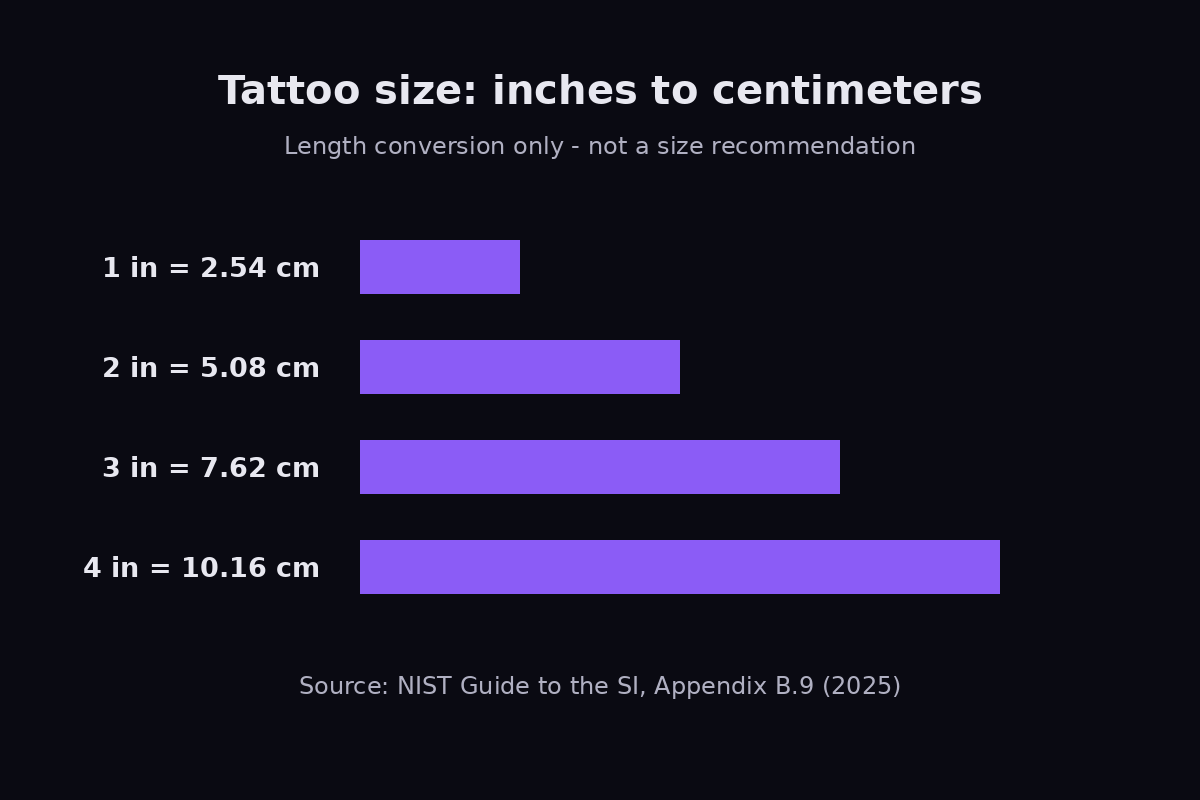
The National Institute of Standards and Technology (NIST), Guide to the SI, Appendix B.9 (updated 2025), gives 1 inch = 2.54 centimeters. Other conversions below multiply that factor. This tool sends no inputs and saves no inputs.
Example: a reference measuring 4 × 6 cm becomes 8 × 12 cm at 200% scale. This is a geometry example, not a placement recommendation. Ask your artist to assess the actual size and detail.
Describe what matters
Write a tattoo design brief
A brief is a short description for your artist. Start with the subject and its personal meaning. Then separate essential elements from optional details. Give the artist room to propose a composition.
For a memorial rose, for example, explain why the flower matters. Decide whether a name, handwriting, or date belongs in the design. Bring the original handwriting if you want the artist to discuss it. Check the spelling yourself before you approve any final artwork.
- Subject: Describe the main image in plain words.
- Visual direction: Describe the outlines, shading, and colors you prefer.
- Placement: Name the body area and the direction you want the image to face.
- Priorities: Mark the details you want to keep and those you can change.
Use references to explain individual choices. You might like the empty space in a drawing or the shape of its border. Label those preferences. Ask for an original interpretation instead of requesting a copy of another person's tattoo.
Discuss size before fine detail
Use the calculator to compare the same composition at different widths. Measure the artwork itself rather than the surrounding page margin. Record both dimensions with their unit. A screenshot without measurements leaves your intended size unclear.
Try a paper outline against the proposed body area. Check it while you stand, sit, and move. Treat this as preparation for a conversation. Your artist must decide how the design fits the body's shape.
Ask which details need more space. Discuss lettering separately from decorative lines. Request a stencil review before you agree to the placement. A stencil is the outline used to position the design on the skin.
Prepare questions for the artist
Bring your brief and reference dimensions to the consultation. Ask the artist to explain any proposed changes. Request a written price and clarify what the price includes. Ask about the booking process, design revisions, and care instructions.
Review examples of the artist's work. Ask to see healed examples when available. Explain what you like about each example rather than relying only on a style name. Keep a written note of the choices you agree.
Keep safety separate from design planning
The U.S. Food and Drug Administration (FDA), in “Think Before You Ink: Tattoo Safety” (checked 2026), reports infections from contaminated inks. It also reports allergic reactions. Sealed ink containers can contain microorganisms.
The FDA advises you to contact your health care professional about a suspected infection or other reaction. Tell your tattoo artist too. Ask your artist for care instructions before the appointment. This planning guide provides no medical assessment.
Sources: NIST, Guide to the SI, Appendix B.9, updated 2025; FDA, Think Before You Ink: Tattoo Safety, checked 2026. Review date: 28 October 2026.